A temperature reading needs a location before an operator can interpret it. For air-cooled equipment, a thermal review begins with the air reaching the intake and the environmental requirements of the installed model.
Locate the intake on the installed equipment
Begin with the equipment documentation and the actual rack arrangement. Identify the intake and exhaust orientation, then mark the intended measurement locations on a rack drawing or photograph. Use identifiers that another operator can find later, such as the rack number and equipment position.
For conventional front-to-back equipment, the rack front provides the starting point. Check the arrangement of network equipment and other devices that may use a different airflow direction. Record those exceptions before treating one measurement pattern as representative of the entire rack.
The Department of Energy’s data-center cooling discussion identifies the equipment inlet as the relevant interface for cooling air. Our proposed review starts by giving each location a name, so the team can connect readings to that interface.
Record height as well as rack identity
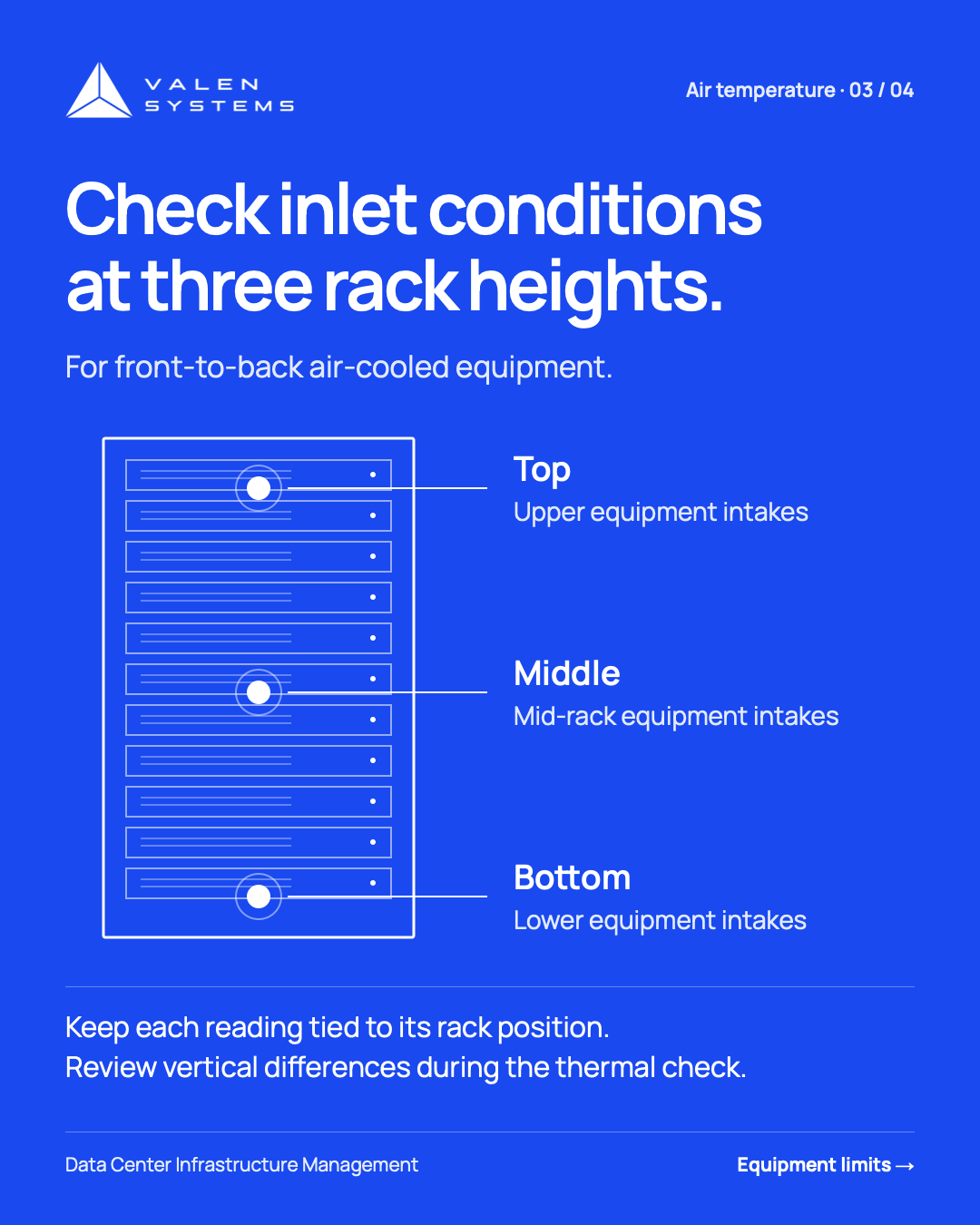
ENERGY STAR’s measurement guidance describes taking inlet readings at the top, middle and bottom of a rack. Those positions help reveal differences that a single rack reading could miss. Record the precise probe position used during your review and follow the measurement method agreed for the equipment.
Set up the worksheet before collecting values. Give each row its own location identifier, unit, observation time and sensor reference. Keep the three positions separate when presenting the results. An average by itself would conceal the vertical pattern you set out to examine.
For example, a reviewer who sees a higher top reading needs to know whether all three values came from the same observation period and whether the probes were placed at comparable intake positions. If those details are absent, assign a follow-up observation rather than treating the pattern as established.
Keep supply, inlet and exhaust records identifiable
Use separate labels for the cooling supply, the equipment inlet and the equipment exhaust. Include those labels in exports as well as in the monitoring interface. A copied chart should retain enough context for someone outside the original investigation to understand its location.
A simple review sheet can group the records this way:
- Supply: identify where the cooling air was measured and which part of the installation that point describes.
- Inlet: identify the equipment and the intake position, including the rack height.
- Exhaust: identify the outlet location and its relationship to the equipment being reviewed.
These are suggested documentation fields. Use the site’s measurement procedure to decide which observations are needed and how they should be collected. A missing supply or exhaust record should remain visible in the review notes.
Bring the equipment requirements to the review
Find the environmental specifications for the installed model and configuration. Record the document revision and any conditions that affect its application. This gives the reviewer an identifiable reference when deciding what a reading means.
The DOE design guide explains that ASHRAE’s recommended and allowable environmental envelopes serve different purposes: the recommended envelope supports reliable, efficient operation, while the allowable envelope describes tested functional boundaries. Have the responsible reviewer determine the appropriate requirements for the installed equipment before proposing a cooling change.
Keep the measurement and the decision in separate fields. One field holds what was observed; another identifies the applicable requirement and the reviewer’s conclusion. When the manufacturer documentation or installed configuration is uncertain, record that uncertainty and who will resolve it.
Leave a record that supports a repeat observation
Document the workload and relevant operating state during the review. Note an open door, a recently moved device or an approved maintenance activity if it changes the context of the observations. Preserve the original reading set with its time window, then record any later changes against it.
After an approved adjustment, collect the follow-up observations at the documented locations using the agreed method. If workload or measurement conditions differ, describe the difference alongside the comparison. The reviewer can then decide which conclusions the evidence supports and whether another observation is needed.
The practical deliverable is a rack record that another operator can repeat: identifiable locations, actual readings, applicable requirements and an assigned decision. If the monitoring system cannot supply one of those pieces, that gap is a useful starting point for a discussion with Valen Systems about your data center’s measurement needs.
Sources
- ENERGY STAR — Raise the TemperaturePublication date not stated. Retrieved October 17, 2026.
- DOE — Best Practices Guide for Energy-Efficient Data Center Design, July 2024Publication date not stated. Retrieved October 17, 2026.
- DOE — New Toolkit Helps Save Energy in Two Data Centers—and Potentially Many MorePublication date not stated. Retrieved October 17, 2026.